- Admin
- June 11, 2025
- 0 Comments
- SEO
Generative AI is reshaping the e-Commerce landscape through machine
intelligence which generates text, images, and much more. Doing tasks in
marketing using cutting-edge AI tools is becoming more automated and smarter.
McKinsey
cites that generative AI can create up to $2.6 to 4.4 trillion value a year for
businesses across industries. For example, AI allows for faster content
creation that is personal, more personalized, and made with better data-driven
decisions in online retail.
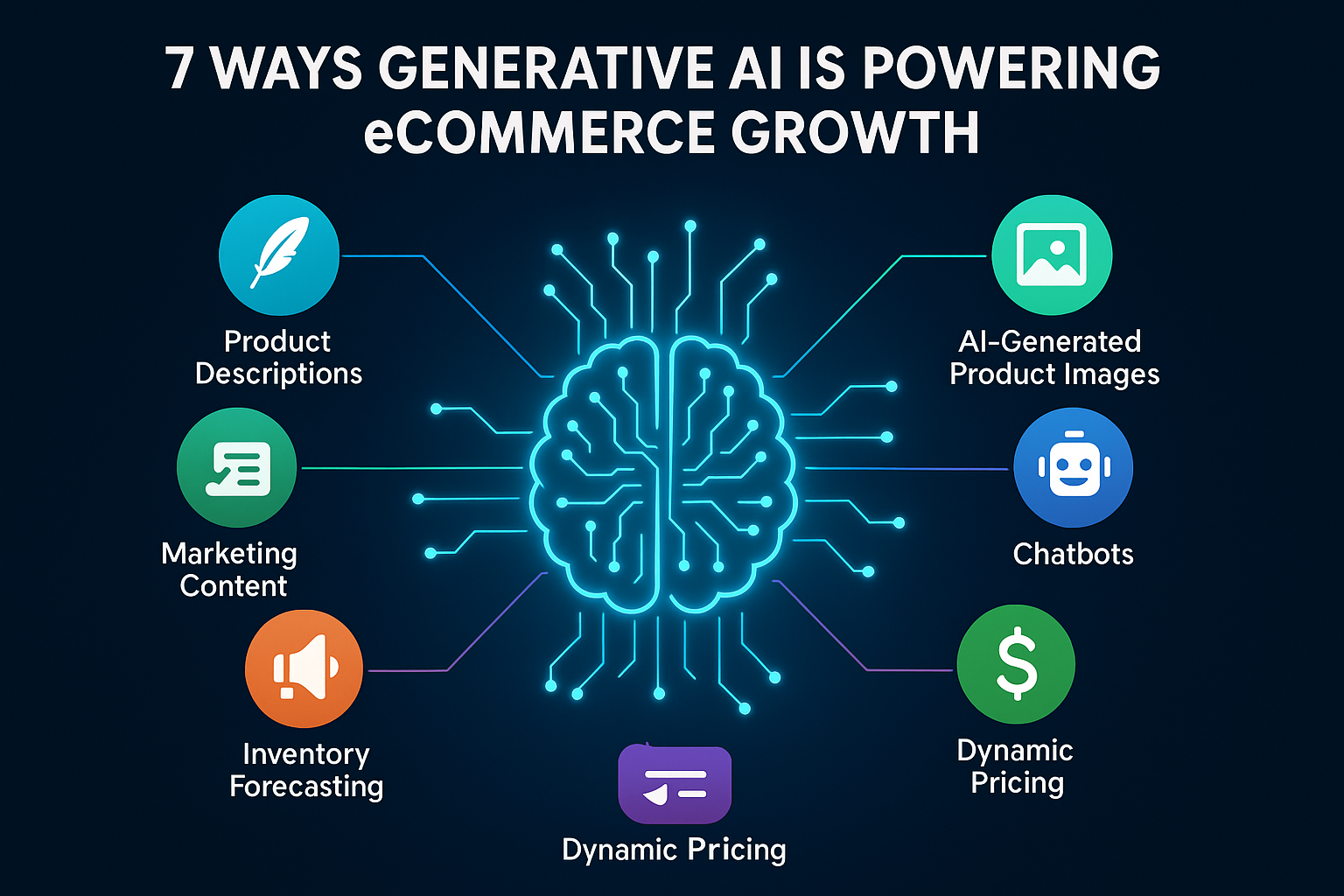
Here is seven
ways generative AI can be used in the e-Commerce space to keep your business
competitive.
1. Product
Description Generation
By far, the
most common use case for an AI when it comes to text generation is writing
unique, engaging product descriptions at scale, both in terms of volume and
complexity.
As a ‘digital
copywriter’, generative AI can write out SEO-optimized descriptions with a
focus on key features, brand voice, etc. A description can influence as many as
82 percent of shoppers in choosing to buy, and 20 percent to leave a purchase
if a product description is unclear. AI-powered tools can execute every
listing, which is perfect for visibility and conversion.
● Automated Copywriting
AI models may
produce thousands of descriptions in a matter of seconds. You can give a prompt
about the specification of a product, and the AI comes up with a short,
inspiring blurb, full of suitable keywords. It saves time and ensures thousands
of SKUs stay the same.
●
Brand
Voice & SEO
AI can be
trained by businesses to maintain the copy's tone. The AI model will generate
content that will meet your brand style. It can also inject dynamically
(trending) keywords that improve SEO without manual edits.
●
Personalized
Details
AI can go
further than generic text and place helpful information into context, to
reflect the buyer. For example, if the data indicates that a user searched for
"gluten-free," AI can accentuate this attribute in the description.
Amazon has
started utilizing generative AI to update the titles and descriptions of
"gluten-free" cereals that are displayed to customers. Retailers
scale their catalogues by automation of descriptions.
2. Personalized Customer Experiences
While
generating AI shopping, you can provide a level of hyper-personalization. As
customers are taking the online shopping journey, the customized shopping
journey at every touchpoint can be provided by analyzing past purchases,
browsing patterns & preferences of customers.
● Smart Recommendations
Artificial
Intelligence (AI) can produce intelligent product recommendations. The
one-size-fits-all solution that this tag (such as "Gift boxes for Mother's
Day" or "Cool deals for beginner curlers") provides is not
available in generative models.
●
Tailored
Emails and Advertisements
You can write
your email subject line as well as content with the help of AI. For instance,
in the case of the AI model, they might be writing different promotional
messages for the segments.
Loyalty moves
through personalization – In one survey, 80% of shoppers answered in the
affirmative that they would be more likely to purchase from a brand that
provides a personalized service.
●
Dynamic
Web Content
Sites can
adapt in real time. Home page headlines or banners could be rewritten by the AI
according to current trends or visitor profiles. For example, data of a user
who loves sneakers, the homepage can show running shoes.
The
'AI-driven homepage' makes sure each customer views the most relevant content
and ultimately increases engagement. Businesses exploit generative AI for
personalization as a way to create the idea that shoppers are made to feel
understood and valued.
3. AI-Generated Images and Media
The majority
of generative AI is not limited to just creating text it can be used for
creating rich images and videos for your store. Retailers can create product
photos and marketing visuals without a full photoshoot using DALL·E or Stable
Diffusion.
AI-generated
images can put your product in any context or style — product images can be
turned into dozens of lifestyle images instantly and your product in different
models, in different settings, etc.
The
ultra-real image allows the customers to see the products from various angles
and in a moving environment , which of course will help to place trust in it
and increase the conversion.
● Virtual Photoshoots
Virtual
photoshoots help in creating good-quality images of your product through a
simple input. It is possible for AI to even remove and replace backgrounds,
adjust the lighting or use products in aspirational scenes. Say, a furniture
seller would perhaps use AI to stage a sofa in a modern living room virtually.
It makes
content creation quicker by speeding up the creation process of images. For
example, thousands of images can be created in seconds, which helps to update
content quicker for a seasonal promotion.
●
Consistent
Branding
Consistent
branding means every image with generative tools will look alike in terms of
consistent colour grading, style, and messaging. This helps the brand to be
identified from a big catalogue. The visual personalization applied through AI
is one example of personalization and shows variations that are driven by
customer data (e.g., the product on a model resembling the user's profile).
●
Higher
Engagement
Visuals will
also attract the click-through rates or CTRs and sales. Personalized or
tailored imagery increases the click-through rate by 30% and can also boost
conversion by up to 20 – 26%. AI-generated visuals can be used for ads and
social media to have more effective campaigns without the extra cost of design.
Through the
application of AI image generation, e-commerce sites can now add lucrative and
eye-catching visuals to product pages and paid advertising campaigns, whilst
remaining simple, cheap, and effortless.
4. Chatbots and Virtual Assistants
AI chatbot
brings 24/7 support to your store. The bots that are powered by generative
language models (such as ChatGPT) are capable of a lifelike conversation with
customers on your website, app, or social channels.
Common
questions are answered instantly, they steer the buyer to the products and even
recover the abandoned carts. Automating your first point of contact with
customers gives support teams the time to deal with more serious issues.
● Instant Support & Sales
Chatbot can
handle simple tasks (like placing returns and tracking orders) and can answer
FAQs (shipping info, return info). According
to recent stats, 62% of internet users prefer interacting with an AI
Chatbot for their support needs. More sophisticated personal shopping
assistants are able to actively respond to clients' and customers' questions at
all times.
●
Lead
Generation & Cart Recovery
Beyond
support, chatbots capture leads. They could ask visitors to sign up or offer a
discount in case they are blocked at checkout. Using a proactive chat pop-up
can nudge a person to complete a purchase.
●
Boosting
Engagement
Chatbots can
even use email to send personalized follow-ups on social networks or to
customers' emails. These virtual assistants/chatbots have the ability to keep
the conversation going even when the customer has left the site, by syncing
with the CRM.
5. Dynamic Pricing and Offers
Pricing
optimized with AI helps you, as a business owner, to stay competitive and earn
the highest possible revenue. Generative (and predictive) AI algorithms can
instead suggest changing the price on the fly based on some factors.
The AI model looks at current inventory levels, competitor prices, local demand, time of day, and even social media buzz to know the best price that should be set for every product. By constantly processing these inputs, AI determines price points that maximize profit without giving any customers a reason to leave.
●
Data-Driven
Price Optimization
Modern AI
tools address vast data such as historical sales, stock on hand, competitor
listings, economic indicators, and others. It enables finding complex patterns
overlooked by human analysts.
●
Real-Time
Offers
You can
provide personalized discounts or bundle offers with the help of AI. For
example, imagine that you, as a loyal customer, often shop for running shoes
and with the help of AI, you can auto-generate coupons for the running shoes
you use commonly. For high-demand occasions (like sales), you may also change
prices hourly. You can also lower prices to cover excess inventory.
●
Trust
and Transparency
Dynamic
pricing can increase revenue, but has to be used carefully. According to
Harvard Business Review, price transparency is very important to branding. This
allows for using dynamic pricing tools through which you can tailor your
strategy (match online and in-store pricing) as well as react quickly to the
market shift.
6. Inventory Forecasting and Planning
Another area
where AI really excels is in the management of stock levels. Compared with the
other strategies, the generative and predictive models predict demand more
precisely by learning from historical sales patterns and external signals. It
means buying exactly the right amount of inventory without going through the
expensive territories of overstock or stockouts.
●
Predictive
Demand Forecasts
In-season,
seasonality, and promotions are accounted for in the shoe stock keeping unit or
SKU's past sales analysis by AI. Then, it adjusts the predictions for the
upcoming periods. To bring an example, a retailer selling beach umbrellas in
this case may have a surge in sales in the summer and AI can use weather data
to predict an unusually hot season and suggest ordering some extra stock.
●
Contextual
Inputs
Current
prediction models can take into account commercial and social trends. An AI can
monitor a TikTok trend promoting a toy that suddenly gains popularity and
advise you to produce more. However, a stronger source of forecasts, using the
combination of multiple data sources (store sales, online trends, economic
indicators), is often based on artificial intelligence.
● Optimized Ordering
Forecasts can
become better and businesses can avoid having their cash tied up in unwanted
stock. AI can be used to determine the levels of safety stock and reorder
points. Even if you are using AI suggestions for low-volatility products
(steady demand), you may depend on human expertise.
For the high volatility goods (fashion items), relying less on human inputs will provide better agility. e-Commerce companies by using AI can reduce waste and ensure that customers find the products that are in stock.
7. Marketing Content Automation
AI tools can
create first-copy ideas or full content pieces in blog posts, product guides,
or email campaigns, and captions for social media. It ensures consistency
across all the channels and does not overburden your team along the lines of
messaging.
For instance,
you can instruct an AI to write a 200-word Instagram description for [Product
X], that is ecofriendly in tone, you can prompt something along the lines of
'Write a 200-word Instagram description for [Product X] that talks about how
ecofriendly it is’ and a few seconds later, you will have perfect text.
●
Social
Media & Ad Copy
In an example of taking advantage of the power AI offers, we extend this to spinning up variations of ad headlines, captions, and hashtags to test. You can also generate multiple options instantly and A/B test. It allows marketers to execute the campaign much faster.
●
Email
Newsletters
You can have
the AI read you a lead for your email (“Announcing a summer sale on outdoor
gear”), and it will write an email for you. There are options to make the
content on brand and even to tailor it as per customer segment (like different
intros for new customers vs. returning). It is assumed that 45 per cent of
marketers are already using generative AI in their workflows and this will
increase in the coming years.
● Blog Posts and Articles
Need a blog
idea? Articles/blogs can even be written by AI tools, and the rest of your team
will then need to edit and publish them. Generative AI can help retailers
create product descriptions, social posts, ads, and articles with a couple of
inputs.
Final Thoughts
Generative AI can be described as a revolutionary innovation as it balances what a small team can do through it while providing data-driven strategies. Using AI tools for descriptions, personalization, imagery, chatbots, pricing, forecasting, and content, e-commerce businesses can speed up the process and be smarter about their offerings as well as about the service they provide to their customers.
One of the
realities about these technologies is that they are changing rapidly;
forward-thinking retailers looking ahead will be able to make bets now to learn
and experiment in such a way that they will be better positioned as AI
redefines online commerce.