- Admin
- January 20, 2026
- 0 Comments
- Web Development
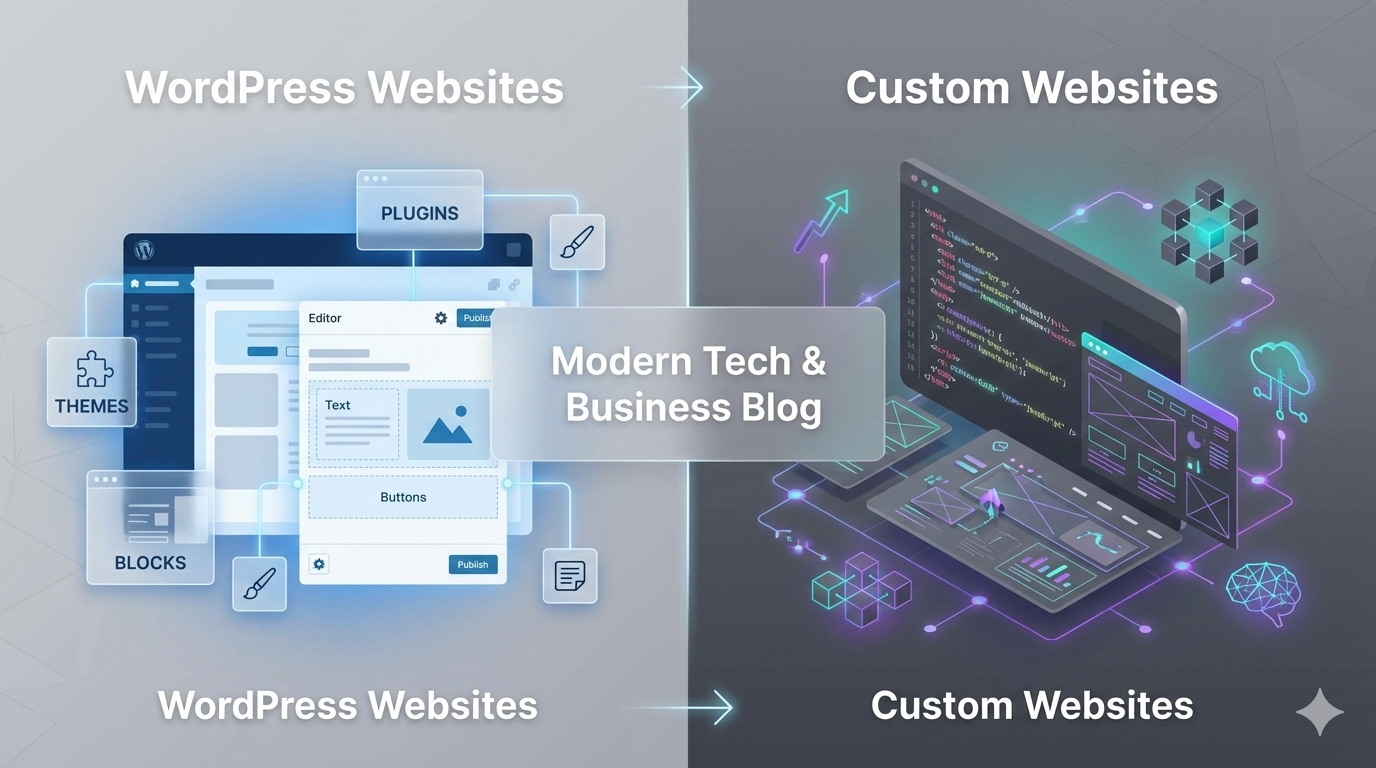
WordPress vs Custom Websites: What Businesses Should Choose in 2026
Choosing the wrong website platform can cost your business thousands in redevelopment, lost traffic, and missed opportunities. In 2026, the decision between WordPress and custom development isn't about which technology is better. It's about which approach aligns with your business goals, technical capabilities, and growth trajectory.
The stakes are higher than they were five years ago. Websites now compete with AI-generated content, voice search optimization, and increasingly sophisticated user expectations. Your platform choice affects everything from page speed and security to how quickly you can adapt to market changes. Both WordPress and custom development have evolved significantly, but they serve different purposes and different businesses.
Overview of WordPress and How It Has Evolved by 2026
WordPress powers a substantial portion of the web and has matured considerably over the past few years. The platform now includes native performance optimizations, enhanced security features, and better integration with modern web technologies. Full-site editing has become standard, giving users more control over design without touching code.
WordPress website development in 2026 benefits from a massive ecosystem. Thousands of themes and plugins extend functionality, and compatibility with headless CMS architectures allows developers to use WordPress as a content backend while building custom frontends with modern frameworks.
The platform has also improved its handling of dynamic content, e-commerce, and membership sites. Performance has been a focus, with core updates addressing speed bottlenecks that plagued earlier versions. For many businesses, WordPress offers a balance between flexibility and accessibility that custom solutions struggle to match at similar price points.
However, WordPress still carries the weight of backward compatibility. Supporting legacy code and older plugins means the core system includes features most modern sites don't need, which can affect performance if not managed properly.
What Custom Websites Are and How Businesses Use Them Today
Custom website development involves building a site from the ground up using programming languages, frameworks, and architectures chosen specifically for your project. There's no pre-built system to work within. Every feature, every function, and every line of code serves your exact requirements.
In 2026, custom development often uses modern frameworks like Next.js, Nuxt, or SvelteKit combined with headless CMS solutions, microservices, and cloud infrastructure. These approaches allow developers to optimize every aspect of performance, security, and user experience without the constraints of a traditional CMS.
Businesses typically choose custom development when they need unique functionality that doesn't exist in plugins, when they're building complex web applications, or when performance and scalability requirements exceed what standard platforms can deliver. Tech companies, enterprise organizations, and businesses with highly specific workflows often find custom solutions more sustainable long-term.
The trade-off is complexity. Custom sites require ongoing developer involvement for updates, feature additions, and maintenance. You can't simply install a plugin to add functionality. Everything requires planning, development, testing, and deployment.
Ease of Use and Management Comparison
WordPress wins decisively on ease of use for non-technical teams. The admin interface is familiar to millions of users. Content editors can publish pages, upload media, and manage site structure without developer assistance. Plugins handle everything from SEO optimization to contact forms with minimal technical knowledge required.
Updates happen through the dashboard. Security patches, theme updates, and plugin maintenance can be managed by marketing teams or virtual assistants with basic training. This accessibility reduces dependency on developers for day-to-day operations.
Custom websites require technical expertise for almost everything beyond basic content updates. Even simple changes like adjusting a form field or modifying navigation might need developer involvement. Some custom builds include content management interfaces, but these are only as good as the time and budget invested in building them.
For businesses without in-house technical teams, this creates a dependency on development agencies or freelancers. Response times for updates depend on developer availability, which can slow down marketing initiatives and time-sensitive campaigns.
Design Flexibility and Branding Control Comparison
WordPress themes provide starting points that can be customized to varying degrees. Premium themes offer extensive options panels where you can adjust colors, fonts, layouts, and components. Full-site editing expands this control, allowing visual customization of templates without code.
However, themes inherently constrain design. You're working within the structure the theme developer created. Achieving a truly unique design often requires custom CSS, template modifications, or hiring a developer to build a custom theme. Complex animations, unusual layouts, or brand-specific interactions may be difficult or impossible to implement within theme limitations.
Custom development offers complete design freedom. There are no templates to work around, no theme limitations to overcome. Designers can create exactly what they envision, and developers can implement it without compromise. Every interaction, every animation, and every layout can be tailored to brand requirements.
This freedom matters most for brands where website design is a competitive differentiator. If your site needs to stand out visually or provide experiences that standard themes can't deliver, custom development is often the only viable path.
Performance, Speed, and Scalability Differences
Website performance and security have become critical ranking factors and user experience determinants. WordPress can be fast when properly optimized, but it requires deliberate effort. Out of the box, WordPress loads the entire theme, various scripts, and database queries that may not be necessary for every page.
Optimization requires caching plugins, image optimization, lazy loading, CDN integration, and careful plugin selection. Each plugin adds code, database queries, and potential performance overhead. A poorly chosen plugin can significantly slow your site. Managed WordPress hosting helps, but adds recurring costs.
Scalable websites built on WordPress can handle significant traffic with the right infrastructure, but scaling typically involves upgrading hosting resources rather than optimizing code efficiency.
Custom websites can be engineered for performance from the start. Developers control exactly what code loads, how assets are delivered, and how data is processed. Modern frameworks support static site generation, incremental builds, and edge deployment that deliver exceptional speed.
Scalability in custom development depends on architecture choices. Well-built custom sites can handle massive traffic efficiently because they're designed specifically for the expected load and growth patterns. However, poorly built custom sites can perform worse than WordPress if developers lack expertise in performance optimization.
Security, Maintenance, and Long-Term Stability
WordPress security has improved substantially, but the platform's popularity makes it a target. Vulnerabilities in themes and plugins create most security issues, not the core software itself. Regular updates are essential. Outdated plugins or themes can expose sites to attacks.
Maintenance involves updating core WordPress, themes, and plugins regularly. Compatibility issues sometimes arise when updates conflict with customizations or other plugins. Sites require monitoring, backups, and occasionally troubleshooting when updates break functionality.
The positive side is that security patches are released quickly, and the community identifies vulnerabilities rapidly. Managed WordPress hosts often handle core updates automatically and provide security monitoring.
Custom websites have smaller attack surfaces because there's no standard codebase for hackers to target. Security depends entirely on code quality and development practices. Well-built custom sites can be extremely secure because developers implement only necessary features and follow security best practices specific to the project.
Maintenance for custom sites requires ongoing developer access. Security updates for underlying frameworks, libraries, and dependencies need regular attention. Without active maintenance, custom sites can become vulnerable as dependencies age.
Long-term stability differs significantly. WordPress has existed for two decades and will continue indefinitely. Your site won't become obsolete because the platform disappeared. Custom sites depend on the frameworks and technologies chosen. If a framework loses support or a development agency closes, finding developers to maintain the site becomes challenging.
SEO Capabilities of WordPress vs Custom Websites
WordPress offers strong SEO capabilities through plugins like Yoast, Rank Math, and All in One SEO. These tools provide on-page optimization guidance, XML sitemaps, schema markup, and technical SEO features that non-technical users can implement. The platform's structure supports SEO fundamentals like clean URLs, proper heading hierarchy, and mobile responsiveness.
WordPress also integrates easily with analytics platforms, search console, and SEO tools that marketers rely on. The plugin ecosystem means new SEO features and capabilities can be added as search engines evolve.
Custom websites require developers to implement SEO features manually. Everything from meta tags to structured data to XML sitemaps needs to be coded. The advantage is complete control over technical SEO implementation without plugin overhead affecting performance.
Developers can optimize crawl efficiency, implement advanced schema markup, and create SEO architectures that WordPress plugins can't achieve. For complex sites with sophisticated SEO requirements, custom development allows strategies that would be impossible in WordPress.
However, this requires developers who understand SEO deeply. A custom site built by developers unfamiliar with SEO best practices may perform worse than WordPress with proper plugins configured.
Cost Comparison, Short-Term and Long-Term Considerations
WordPress website development costs vary widely. Basic sites using premium themes might cost a few thousand dollars. Custom WordPress theme development ranges from moderate to significant investment depending on complexity. Hosting adds ongoing costs that increase with traffic and performance requirements.
Plugin licenses, premium themes, and managed hosting create recurring expenses. These are generally affordable for most businesses but accumulate over time. DIY WordPress sites can be built inexpensively, though quality and functionality reflect the investment.
Custom website development requires larger upfront investment. Building from scratch costs significantly more than WordPress because everything must be developed rather than assembled from existing components. Simple custom sites start where complex WordPress projects end, and sophisticated custom builds can require substantial budgets.
However, long-term costs can favor custom development for certain businesses. Without plugin licenses, premium theme fees, and potentially lower hosting costs due to better performance, the total cost of ownership over five years may be comparable or even lower for custom sites.
The calculation depends on maintenance needs, update frequency, and whether in-house developers can handle ongoing work. Businesses without technical teams typically find WordPress more cost-effective long-term despite recurring fees.
Which Option Suits Startups, SMEs, and Enterprise Businesses
Startups benefit from WordPress when speed to market matters most. Launching quickly with a professional-looking site allows testing business models and acquiring customers without massive upfront website investment. WordPress provides the flexibility to evolve as business models change.
Custom development makes sense for startups building web applications rather than informational sites, or when the website itself is the product. If your competitive advantage relies on unique functionality or user experience, custom development may be necessary despite higher costs.
Small and medium enterprises typically thrive on WordPress. The platform handles most business website needs effectively. E-commerce, lead generation, content marketing, and customer portals can all be built on WordPress with plugins and customizations. The ecosystem supports growth without requiring complete rebuilds.
SMEs should consider custom development when they've outgrown WordPress capabilities, when performance at scale becomes critical, or when unique functionality provides competitive advantage. Transitioning from WordPress to custom development after validating business models and understanding exact requirements often makes strategic sense.
Enterprise businesses evaluate both options based on specific needs. Marketing websites, blogs, and content hubs often run on WordPress because content teams can manage them independently. Complex applications, customer portals, and systems requiring integration with enterprise software typically need custom development.
Large organizations sometimes use hybrid approaches, running WordPress for content-heavy properties while building custom applications for specialized needs. This leverages the strengths of both approaches.
Key Factors Businesses Should Evaluate Before Making a Decision
Consider your team's technical capabilities honestly. If no one on staff can handle code, WordPress provides independence that custom sites can't match. If you have developers or budget for ongoing development support, custom sites become viable.
Evaluate your timeline. WordPress sites can launch in weeks. Custom development requires months for even moderately complex projects. If market timing is critical, WordPress may be the only realistic option.
Assess your growth projections and how your website needs might change. WordPress handles evolution well through its plugin ecosystem. Custom sites require redevelopment for major changes but can be architected for anticipated growth if requirements are clear.
Consider how important website performance is to your business model. If milliseconds affect conversion rates or user experience is your primary differentiator, custom development's performance advantages may justify the investment.
Think about long-term control and ownership. WordPress sites can be migrated between hosts and agencies relatively easily. Custom sites create dependency on specific developers or agencies unless thoroughly documented and built with maintainability in mind.
Budget realistically for ongoing costs, not just initial development. WordPress requires hosting, licenses, and occasional development support. Custom sites need developer retainers or in-house technical staff for maintenance and updates.
Making the Right Choice for Your Business in 2026
Neither WordPress nor custom development is universally superior. WordPress excels for businesses prioritizing speed, cost-effectiveness, and marketing team independence. It serves most business website needs well and has evolved to handle sophisticated requirements that once demanded custom solutions.
Custom development delivers unmatched performance, design freedom, and functionality when requirements demand it. Businesses building web applications, requiring unique user experiences, or operating at scale where performance directly impacts revenue often find custom development worth the investment.
The decision shouldn't be made by technology preference alone. Start with business goals, user needs, and operational realities. A digital agency or web consultant can help evaluate specific requirements against both platforms' capabilities, but the strategic decision rests on understanding what your business actually needs from its web presence.
Many businesses start with WordPress and transition to custom development as they grow and requirements become clearer. Others build custom from the start because their business model demands it. The right choice in 2026 depends less on which technology is better and more on which approach aligns with where your business is today and where it needs to go tomorrow.
Recent Articles
-
 AI Content vs Human Content: What Ranks Better in 2026?January 29, 2026
 -
 5 Red Flags Your Marketing Strategy Is Wasting MoneyJanuary 21, 2026
 -
WordPress vs Custom Websites: What Businesses Should Choose in 2026January 20, 2026